Air Source Heat Pump UK 2026
Boiler Upgrade Scheme Guide ·
Air Source Heat Pump UK: Costs, Grants, and Whether Your Home Is Ready (2026)
An air source heat pump installed in a UK home in 2026 costs between £8,000 and £15,000 before any government support. After the Boiler Upgrade Scheme grant of £7,500, most homeowners pay between £500 and £7,500 out of pocket. For households on qualifying benefits, ECO4 can fund the full installation at no cost at all. The right starting point is not choosing a system — it is working out which of those two routes applies to you.
Please note: InstantGrant is an independent grant information and application-support service. We are not the UK government, Ofgem, or any funding body, and we do not install heat pumps or award grants. All figures on this page reflect 2026 scheme data verified against GOV.UK, Ofgem, and the MCS website. Always confirm current grant amounts and eligibility criteria before committing to any installation work.
This guide covers how air source heat pumps work, what they cost, which grants apply, and — the question most guides skip — whether your specific home is a realistic candidate.
How an Air Source Heat Pump Actually Works
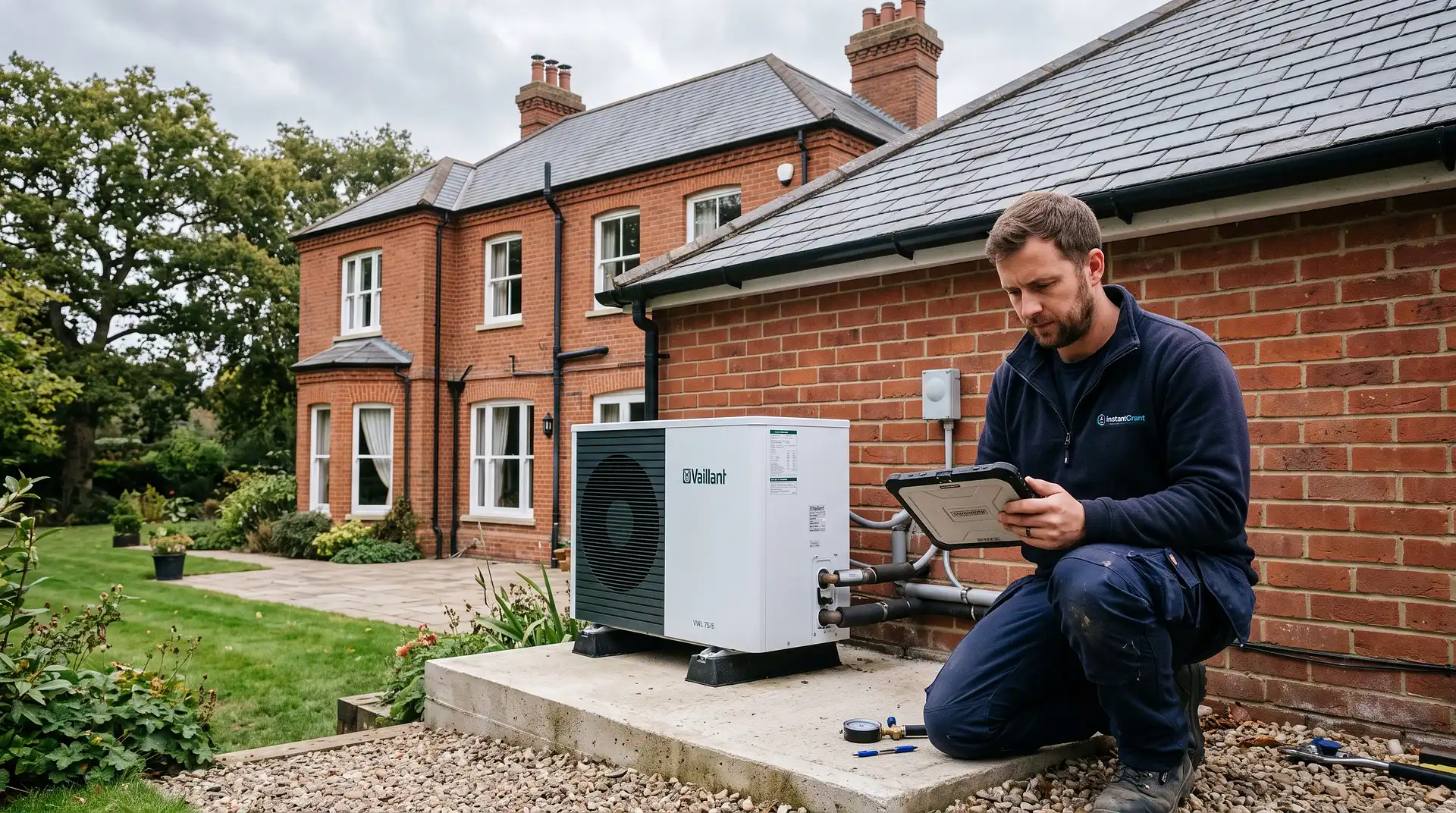
An air source heat pump pulls thermal energy from outdoor air and moves it inside your home to heat radiators, underfloor heating, and hot water. Even on a January morning in Manchester or Aberdeen, there is enough heat energy in the air for the system to work. Most heat pumps operate efficiently down to around minus 15 degrees Celsius outside.
The SCOP: What Efficiency Actually Means for Your Bills
Every heat pump has a Seasonal Coefficient of Performance, or SCOP. This tells you how many units of heat the system delivers for every unit of electricity it uses across a full heating season.
A gas boiler converts fuel to heat at around 85 to 90 percent efficiency — so for every £1 you spend on gas, you get roughly 90p worth of heat. A heat pump with a SCOP of 3.0 produces £3 worth of heat for every £1 of electricity. That is the fundamental efficiency advantage, and it is why a well-installed heat pump in a suitable home can undercut gas running costs even though electricity costs more per unit than gas.
The word "well-installed" matters. A heat pump set up incorrectly by an installer who does not configure weather compensation will run harder than necessary, push the SCOP down toward 2.0, and cost more to run than it should. This is the single most important quality factor in any heat pump installation, and it is covered in more detail below.
Air-to-Water vs Air-to-Air: Which Are We Talking About?
Most UK homes that install a heat pump install an air-to-water system. This works exactly like a central heating boiler — it heats water, which circulates through your radiators and hot water cylinder. The heat pump replaces the boiler as the heat source.
An air-to-air heat pump is different. It moves warm air directly around rooms through fan units mounted on interior walls, without using water or radiators at all. It heats spaces efficiently and can also cool them in summer, but it does not heat domestic hot water. For homes with wet central heating systems — radiators, a cylinder, pipework — air-to-air cannot replace a boiler by itself.
For the purposes of this guide, air-to-water is the system most homeowners considering a boiler replacement should focus on. Air-to-air has its own section below covering where it makes sense and what grant applies.
Air Source Heat Pump Costs in 2026
Installed Costs Before Grants
Property Size | Typical Installed Cost (Before Grant) |
|---|---|
Small flat or 1-bed property | £8,000 to £10,000 |
2 to 3-bed semi or terrace | £9,000 to £12,000 |
3 to 4-bed detached | £11,000 to £15,000 |
Larger detached or older property | £13,000 to £18,000+ |
These figures cover the heat pump unit, labour, a new hot water cylinder (most installations need one), commissioning, and MCS certification paperwork. They do not include radiator upgrades, which are sometimes needed and are covered below.
What Drives the Cost Up
Cylinder replacement. Most heat pump installations need a new unvented hot water cylinder, which costs between £1,200 and £2,500 depending on size and insulation specification.
Radiator upgrades. Heat pumps work at lower flow temperatures than gas boilers — typically 40 to 50 degrees rather than 70 to 80 degrees. Some older or smaller radiators cannot emit enough heat at those lower temperatures and need replacing with larger ones. An average radiator replacement costs £150 to £400 per room. Whether your existing radiators are adequate is something a heat loss calculation determines.
Ground works for pipework. Some installations require trenching to bring pipework from the external unit into the property. This is a relatively minor cost on a detached house but can be more involved on a semi or terraced property where the unit placement is more constrained.
Older properties with solid walls. Solid wall homes — common in Victorian terraces across Leeds, Newcastle, Bristol, and most other large UK cities — lose heat faster than cavity wall or insulated properties, which means the heat pump needs to run harder to maintain temperature. Solid wall insulation significantly improves performance but adds cost.
Government Grants for Air Source Heat Pumps in 2026
Boiler Upgrade Scheme: £7,500 Standard / £9,000 for Oil and LPG Homes
The Boiler Upgrade Scheme provides £7,500 off the installed cost of an air-to-water air source heat pump for eligible homeowners in England and Wales. There is no income test. You do not need to be receiving benefits. You need to own the property and be replacing a fossil fuel heating system.
If your home currently runs on oil or LPG rather than mains gas, the grant increases to £9,000 from 21 July 2026. This uplift runs until 31 March 2027, after which oil and LPG homes return to the standard £7,500 rate.
The grant is deducted directly from your installer's quote. You never handle the money — your MCS-certified installer applies to Ofgem and claims it after installation.
ECO4: Free Heat Pump for Qualifying Households
If someone in your household receives Universal Credit, Pension Credit, or certain other means-tested benefits, and your home is rated EPC band D to G, you may qualify for a fully funded heat pump through ECO4. In this case, the entire installation — unit, labour, cylinder, and sometimes radiator upgrades — is covered at no cost to you.
ECO4 closes on 31 December 2026. If you think you may qualify through this route, the time to start the process is now, not when the scheme is weeks from closing.
Warm Homes: Local Grant
Lower-income households in England with income under £36,000 and homes rated EPC D to G may qualify for the Warm Homes: Local Grant, administered by local councils. This can fund low-carbon heating including heat pumps for eligible households in participating areas. Check with your local council whether your area is running the scheme.
Air-to-Air Heat Pumps: £2,500 Grant
Air-to-air heat pumps became eligible for the Boiler Upgrade Scheme in April 2026 with a £2,500 grant for domestic properties in England and Wales. The lower grant reflects that air-to-air heats spaces but not water, making it a partial rather than complete heating replacement in most homes. For properties heated entirely by electric panel heaters or storage heaters — where hot water is already electric — air-to-air can work well as a whole-house heating upgrade at a lower total installation cost.
Grant Availability by UK Nation
Nation | BUS (Air-to-Water) | BUS (Oil/LPG Uplift) | ECO4 | Alternative Scheme |
|---|---|---|---|---|
England | £7,500 — Open | £9,000 to March 2027 | Yes — closes Dec 2026 | Warm Homes: Local Grant |
Wales | £7,500 — Open | £9,000 to March 2027 | Yes — closes Dec 2026 | Nest scheme |
Scotland | No | No | Yes — closes Dec 2026 | Home Energy Scotland |
Northern Ireland | No | No | No | Affordable Warmth / Invest NI |
Scotland
The Boiler Upgrade Scheme does not operate in Scotland. Scottish homeowners can access heat pump support through Home Energy Scotland, which offers interest-free loans of up to £15,000 and cashback grants for heat pump installations. This runs separately from any UK-wide scheme and is available to homeowners across Scotland regardless of income. Call Home Energy Scotland free on 0808 808 2282, Monday to Friday. Households in Argyll and Bute, the Highlands, Moray, or island communities are particularly well-served by this route given the concentration of oil-heated properties in rural Scotland.
Wales
Wales is covered by the Boiler Upgrade Scheme on the same terms as England. Welsh households who cannot access BUS — for example because they are tenants rather than owners — may be able to apply through the Nest scheme, the Welsh Government's equivalent for lower-income households. Contact Nest at nestwales.org.uk.
Is Your Home Suitable for an Air Source Heat Pump?
This is where most people need honest guidance rather than a checklist. The answer is rarely a flat yes or no — it depends on how the home performs now and what work, if any, would make the difference.
Insulation: The Foundation
A heat pump works best in a home that retains heat well, because it delivers warmth at lower temperatures continuously rather than blasting heat periodically like a boiler. A home with good loft insulation, cavity wall fill, and double or triple glazing is a strong candidate. A home with single glazing, uninsulated solid walls, and a drafty suspended timber floor will need more work to get the best from a heat pump.
This does not mean poorly insulated homes cannot have a heat pump — it means the installer needs to right-size the system for the actual heat loss, and that improving insulation before or alongside the installation improves both performance and running costs.
Radiators: The Honest Assessment
Existing radiators in many UK homes were sized for gas boiler flow temperatures of 70 to 80 degrees Celsius. A heat pump works at 40 to 50 degrees. A radiator that was sized tightly for gas may not emit enough heat at heat pump temperatures.
The way to find out is a heat loss calculation — a room-by-room assessment of how much heat each space needs and whether existing radiators deliver that at lower flow temperatures. A good installer will do this calculation before quoting, not after. If an installer quotes a system without doing a heat loss calculation, that is a clear signal to get a second opinion.
Not every home needs new radiators. Many mid-sized to larger radiators from the 1990s onwards are adequate. The calculation tells you which ones need replacing, rather than assuming all of them do.
Outdoor Space for the Unit
An air source heat pump needs an outdoor unit roughly the size of a large air conditioning condenser. It needs to be positioned where airflow is unrestricted — not boxed into a narrow side passage or enclosed courtyard. It also produces a low-level noise, similar to a quiet dishwasher, which matters for placement relative to neighbouring properties and bedroom windows.
On a detached house with a garden, this is almost never a problem. On a mid-terrace in an urban street or a flat in a converted building, it requires more thought.
Planning Permission: When You Need It
Most air source heat pump installations in England, Scotland, and Wales fall under permitted development rights and do not require a planning application. However, you do need planning permission if:
The property is a listed building
The property sits in a conservation area and the unit is visible from a public road
The installation is on a flat or within a flat (permitted development rights for flats are more restricted)
Your local council has specific Article 4 Directions removing permitted development rights in your area
If you live in an older stone property in a conservation area — the Yorkshire Dales, the Cotswolds, parts of Edinburgh's New Town — check with your local planning authority before going further. Most reputable installers will confirm permitted development status as part of their survey, but you should raise it explicitly.
Weather Compensation: The Most Important Setting Nobody Talks About
Weather compensation is a control setting that adjusts the temperature of water your heat pump sends into the radiators based on how cold it is outside. On a mild October day, it runs at 35 degrees. On a bitter January night, it runs at 50 degrees. Without this setting configured correctly, the heat pump runs at a fixed high temperature regardless of the weather — which is inefficient, expensive, and the main reason some homeowners report disappointing running costs.
Every modern heat pump has weather compensation built in. The issue is that some installers do not set it up properly, either because they have come from a gas boiler background where it was less critical, or because it takes longer to configure. Before you agree any installation, ask specifically how your installer will set up and calibrate weather compensation. The answer tells you a great deal about their competence with heat pump systems.
Running Costs: Heat Pump vs Gas vs Oil
Running costs depend on your home's insulation, the system's SCOP, and what fuel you are replacing.
Heating System | Estimated Annual Cost (3-bed, 2026 prices) |
|---|---|
Gas boiler | £850 to £1,100 |
Air source heat pump (standard tariff) | £700 to £1,000 |
Air source heat pump (smart overnight tariff) | £500 to £750 |
Oil boiler | £1,100 to £1,600 |
LPG boiler | £1,400 to £2,000 |
Electric storage heaters | £1,300 to £1,800 |
The running cost gap between a heat pump on a standard tariff and a gas boiler is modest for an average home in 2026. The bigger savings come from replacing oil, LPG, or electric heating.
Smart Tariffs: The Running Cost Difference
The biggest opportunity for heat pump owners to reduce bills is a heat pump-specific electricity tariff. Products like Octopus Cosy or Intelligent Octopus offer significantly cheaper overnight electricity rates, and a heat pump with a properly sized hot water cylinder can do most of its heating work during cheap-rate hours. For a well-configured system on a smart tariff, annual savings of £200 to £400 compared to a standard electricity rate are realistic.
This is not automatic — it requires both the right tariff and correct system configuration. Ask your installer how the system can be set up to take advantage of time-of-use tariffs.
Air Source Heat Pumps and Property Value
Research from property analysts and estate agents consistently shows that heat pumps and high EPC ratings add measurable value to UK homes. Estimates range from 2 to 5 percent uplift in property value, though this varies significantly by location and property type. In areas where EPC C is becoming a buyer expectation — particularly for younger buyers or those buying with an environmentally aware lender — properties with heat pumps already installed attract stronger interest.
This is relevant particularly in cities like Bristol, Cambridge, Oxford, and Brighton where low-carbon credentials carry weight in the buyer market.
Frequently Asked Questions
How much does an air source heat pump cost in the UK in 2026? Between £8,000 and £15,000 installed before any grant, depending on property size and what additional work is needed. After the £7,500 Boiler Upgrade Scheme grant, most homeowners pay between £500 and £7,500.
What government grant is available for an air source heat pump? The Boiler Upgrade Scheme provides £7,500 in England and Wales, rising to £9,000 for homes on oil or LPG until March 2027. ECO4 can fund the full cost for households on qualifying benefits. Scotland has Home Energy Scotland loans and cashback.
Does an air source heat pump work in cold UK winters? Yes. Modern air source heat pumps operate efficiently down to approximately minus 15 degrees Celsius. British winters rarely approach that threshold even in the coldest parts of Scotland.
Do I need new radiators with a heat pump? Not necessarily. A heat loss calculation — which any competent installer carries out before quoting — determines whether your existing radiators are adequate at lower heat pump flow temperatures. Some rooms may need larger radiators; many will not.
Do I need planning permission for an air source heat pump? Most installations are permitted development and do not require planning permission. Exceptions include listed buildings, some conservation areas, and flats. Check with your local planning authority if you are unsure.
What is weather compensation and why does it matter? Weather compensation adjusts the temperature the heat pump sends to radiators based on outdoor temperature. When set up correctly it significantly improves efficiency and reduces running costs. Always ask your installer how they configure this before committing to a quote.
Is an air source heat pump worth it in 2026? For most UK homeowners replacing oil or LPG heating, yes — the economics are strong even before the grant, and the £7,500 or £9,000 uplift makes them compelling. For gas-heated homes with poor insulation, the case is more nuanced and depends heavily on whether insulation improvements are made alongside the installation.
Can I get a free air source heat pump? Through ECO4, yes — if you receive qualifying means-tested benefits and your home is EPC D or below. ECO4 closes 31 December 2026. Contact your energy supplier now if you think you may qualify.
How InstantGrant Can Help
Working out which grant route applies to your situation — Boiler Upgrade Scheme, ECO4, Warm Homes Local Grant, or Scotland's Home Energy Scotland — and understanding how they interact before you commit to an installer takes time. Getting it wrong can mean paying for something that could have been partially or fully funded.
InstantGrant is an independent information and application-support service for UK homeowners. We help you understand your eligibility, work out which scheme fits your situation, and approach the process with the right questions before anyone starts any work.
We are not the government, Ofgem, or any installer. We do not award grants and we do not guarantee outcomes. We help you start the process with clear information.
Check your eligibility at instantgrant.co.uk