ECO Affordable Warmth Scheme
ECO4 Guide ·
ECO Affordable Warmth Scheme 2026: What It Was, What Replaced It, and What NI Households Use Now
The phrase "ECO affordable warmth scheme" means different things depending on when you last looked into it and where in the UK you live. The old ECO Affordable Warmth eligibility group — which existed through ECO1, ECO2, and ECO3 — was quietly phased out when ECO4 launched in April 2022. The current ECO4 scheme replaced it with two separate routes: a benefits-based eligibility group and a local authority referral route called ECO4 Flex.
Important: InstantGrant is an independent grant information and application-support service. We are not the UK government, Ofgem, the Northern Ireland Housing Executive, or any energy supplier. We do not administer any grant scheme. All information on this page is verified against GOV.UK, Ofgem, NIHE, and official Northern Ireland government sources as of August 2026. Always confirm current eligibility and scheme status with the relevant official body before applying.
If you live in Northern Ireland, the picture is entirely different. The Affordable Warmth Scheme in NI is a separate programme run by the Northern Ireland Housing Executive — completely distinct from ECO4, the Boiler Upgrade Scheme, and any GB-wide scheme. This guide covers all of it clearly.
What the "ECO Affordable Warmth" Group Actually Was
Between 2013 and 2022, the ECO scheme had a specific eligibility category called the Affordable Warmth group. This allowed households in or at risk of fuel poverty to access ECO-funded home energy improvements without needing to receive a specific means-tested benefit. Eligibility was based on a combination of income, tenure, and property energy performance rather than benefit status alone.
Why It No Longer Exists
When ECO4 launched in April 2022, the Affordable Warmth group was not carried forward in its original form. ECO4 restructured eligibility into two routes that together cover most of the same ground — but the old terminology was dropped.
If you have been searching for the ECO Affordable Warmth scheme based on something a neighbour told you or something you read a few years ago, the scheme by that name is no longer available. What replaced it is covered in the next two sections.
What ECO4 Uses Instead in 2026
Route 1: The Benefits-Based Route
ECO4's primary eligibility route covers households where someone receives a qualifying means-tested benefit. The list includes Universal Credit, Pension Credit, Income Support, income-based JSA, income-related ESA, Housing Benefit, Child Benefit, Child Tax Credit, and Working Tax Credit. Your home must also be rated EPC band D, E, F, or G.
This route directly replaces the old Affordable Warmth group for most benefit-receiving households. The practical difference is that ECO4 takes a whole-house approach — rather than installing a single measure, it funds a package of improvements designed to bring your home up by at least two EPC bands.
Route 2: ECO4 Flex — The Nearest Equivalent to Old Affordable Warmth
ECO4 Flex is the route that most closely resembles the old Affordable Warmth group in spirit. Your local council refers you to ECO4 based on low household income, fuel poverty risk, health vulnerability, or other local criteria — without needing a specific qualifying benefit.
Each council sets its own threshold, but most use a gross household income of around £31,000 to £36,000 as a guide. Households where someone has a health condition worsened by cold, where a resident is aged 65 or over, or where a child under five lives permanently are commonly included in local ECO4 Flex criteria.
To access ECO4 Flex, contact your local council's housing or energy efficiency team directly. This route does not go through an energy supplier first.
ECO4 closes 31 December 2026. Given a processing time of 10 to 18 weeks, new applications started after mid-September 2026 may not complete before the scheme ends.
The Northern Ireland Affordable Warmth Scheme: A Completely Separate Programme
Northern Ireland runs its own home energy grant system entirely separate from the rest of the UK. ECO4, the Boiler Upgrade Scheme, and the Warm Homes: Local Grant all operate in Great Britain — none of them apply in Northern Ireland.
What the Affordable Warmth Scheme Covers
The Affordable Warmth Scheme is Northern Ireland's main energy grant for lower-income households. It is funded by the Department for Communities and delivered by the Northern Ireland Housing Executive. The scheme covers insulation, boiler replacement, central heating installation, and related heating system upgrades for homes that are genuinely difficult and expensive to heat.
The grant is worth up to £7,500 per household for standard eligible measures. Where a property needs solid wall insulation — common in older stone cottages, pre-war terraced housing, and rural NI properties — the grant rises to £10,000. There is nothing to repay. The money covers approved works carried out by scheme contractors and is paid directly to them.
Who Qualifies for Affordable Warmth in NI
To qualify, all of the following must apply:
You own the property and live in it as your main residence, or you rent privately with your landlord's written consent
Your total gross annual household income is under £23,000
Your home has identifiable heating or insulation deficiencies
The income threshold is deliberately designed to be generous on disability. Disability-related benefits — including Personal Independence Payment (PIP), Disability Living Allowance (DLA), Attendance Allowance, and Carer's Allowance — are not counted as income when assessing the £23,000 threshold. This means a household receiving £23,000 in wages plus £3,000 in PIP could still qualify, because the PIP element is excluded from the calculation. This detail is missing from almost every guide written about this scheme outside Northern Ireland.
What If My Income Is Above £23,000?
Households whose income sits above the Affordable Warmth threshold are not left without options. The Northern Ireland Sustainable Energy Programme — known as NISEP — is a levy-funded grant scheme overseen by the Utility Regulator. At least 80 percent of NISEP funding is ring-fenced for vulnerable or lower-income households. The income thresholds are higher than Affordable Warmth: typically under £28,000 for a single-person household or under £35,000 for families.
NISEP schemes change each programme year as the Utility Regulator approves new schemes. For current NISEP availability, contact the NI Energy Advice line on 0800 111 44 55 — free, impartial, and staffed by advisers who know the current NI scheme landscape.
How to Apply for the NI Affordable Warmth Scheme
Applications go through the Northern Ireland Housing Executive directly. The NIHE website at nihe.gov.uk covers the current application process. The NI Energy Advice line (0800 111 44 55) is a useful first call before you apply, as advisers can confirm whether the scheme is the right route for your situation and what evidence you will need.
Do not apply through any third-party website that claims to submit NI Affordable Warmth applications on your behalf without first verifying they are an official NIHE delivery partner.
The Warm Homes Plan: What It Is and Why It Does NOT Apply in NI
Several websites, including some well-visited comparison sites, published content in 2026 describing the Warm Homes Plan as applying in Northern Ireland or as having replaced the Affordable Warmth Scheme. This is incorrect and some of those sites have since issued corrections.
The Warm Homes Plan is the UK government's energy efficiency framework for England, Scotland, and Wales. Energy policy is devolved in Northern Ireland, which means Westminster's programmes do not automatically extend to NI. The Warm Homes Plan has no equivalent scheme operating in Northern Ireland at this time.
If a website tells you that the Warm Homes Plan applies in Northern Ireland, treat that source with caution.
What Is Replacing Affordable Warmth: The Warm Healthy Homes Fund
Northern Ireland is in the process of developing a successor to the Affordable Warmth Scheme. The Department for Communities launched the Warm Healthy Homes Strategy 2026 to 2036 in February 2026 — a ten-year fuel poverty plan.
The delivery scheme, the Warm Healthy Homes Fund, is backed by approximately £150 million over its first five years. It is expected to launch from April 2027, with wider eligibility criteria and support for whole-home upgrades including solar PV. A public consultation on the fund's design closed on 19 August 2026.
You cannot apply for the Warm Healthy Homes Fund now. It does not yet exist as an open scheme. Until April 2027, the Affordable Warmth Scheme remains the main route to apply through. Do not delay applying for Affordable Warmth while waiting for the new fund to open — if you qualify now, apply now.
Affordable Warmth Equivalents Across the UK in 2026
Nation | Main Affordable Warmth Route | Income / Benefit Basis | Status |
|---|---|---|---|
England | ECO4 (benefits) and ECO4 Flex (LA referral) | Benefits or low income via council | Closes 31 Dec 2026 |
Scotland | ECO4 via suppliers plus Warmer Homes Scotland | Benefits or low income | ECO4 closes Dec 2026; WHS ongoing |
Wales | ECO4 via suppliers plus Nest scheme | Benefits or low income | ECO4 closes Dec 2026; Nest ongoing |
Northern Ireland | Affordable Warmth Scheme via NIHE | Under £23,000 gross income | Open until March 2028 |
Scotland
Scotland's equivalent to affordable warmth support runs through both ECO4 (via energy suppliers, closing December 2026) and Warmer Homes Scotland, which is funded by the Scottish Government and delivered through Home Energy Scotland. Warmer Homes Scotland has no firm closing date at time of writing and serves low-income and vulnerable households across Scotland including remote communities in Argyll, the Cairngorms, Orkney, and Shetland. The Home Energy Scotland freephone number is 0808 808 2282.
Wales
Welsh households access ECO4 through energy suppliers on the same basis as England. The Nest scheme — administered through Warm Wales — covers lower-income Welsh households not qualifying for ECO4 directly, with particular reach into Welsh language communities and rural areas in Powys, Ceredigion, and Gwynedd.
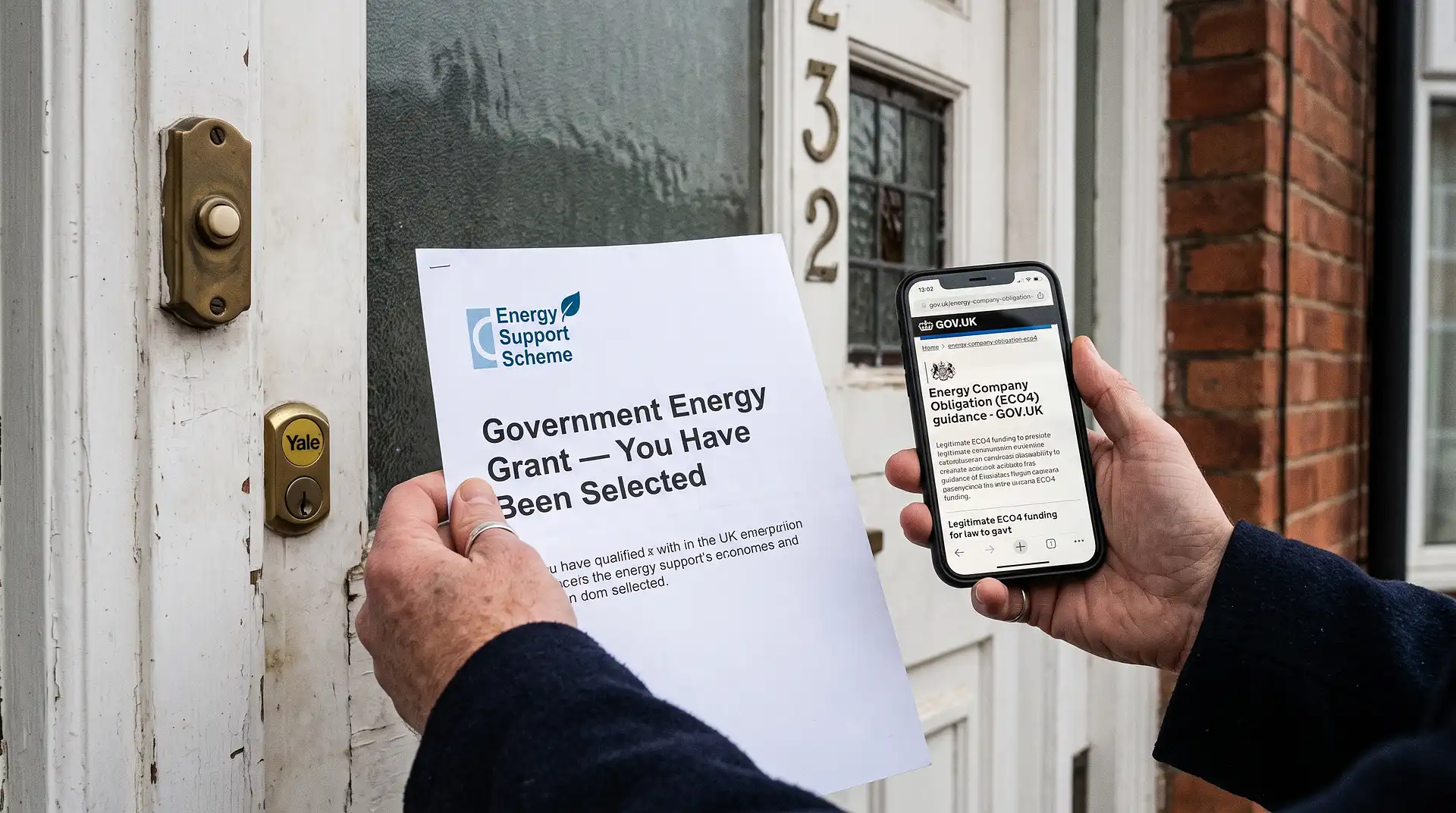
Scam Warnings: Fake Affordable Warmth and ECO4 Offers
Both the ECO4 scheme and the NI Affordable Warmth Scheme attract fraudulent activity. Cold callers and doorstep visitors regularly impersonate government or Housing Executive representatives to extract personal or banking details.
Three things to know:
Legitimate UK government grants and the NI Affordable Warmth Scheme never require an upfront payment from you. If anyone asks for a processing fee, advance payment, or bank details before any work starts, that is fraud.
The NI Housing Executive will not contact you out of the blue telling you that you have been selected for the scheme. Applications go through you making contact, not the other way around.
Any installer or company claiming to process Affordable Warmth applications without a clear connection to the NIHE delivery network should be verified through the NIHE directly before sharing any personal information. Report suspected fraud in Northern Ireland to Action Fraud NI or the PSNI.
Frequently Asked Questions
What is the ECO Affordable Warmth scheme? The ECO Affordable Warmth group was a specific eligibility category within the ECO1, ECO2, and ECO3 schemes that ran between 2013 and 2022. It was phased out when ECO4 launched in April 2022. The two current routes — benefits-based eligibility and ECO4 Flex — cover most of the same ground under different names.
What replaced the ECO Affordable Warmth scheme? ECO4 replaced it. Benefits-based households qualify through the main ECO4 route. Lower-income households without qualifying benefits can access ECO4 Flex through a local council referral. ECO4 closes 31 December 2026.
Is there an Affordable Warmth scheme in Northern Ireland? Yes. The NI Affordable Warmth Scheme is delivered by the Northern Ireland Housing Executive for households with gross income under £23,000. It covers insulation, boiler replacement, and heating upgrades up to £7,500 (or £10,000 for solid wall insulation). It is open until March 2028.
Does the Warm Homes Plan apply in Northern Ireland? No. The Warm Homes Plan is a Great Britain scheme covering England, Scotland, and Wales. Energy policy is devolved in Northern Ireland and Westminster's schemes do not apply there.
Are disability benefits counted toward the £23,000 NI Affordable Warmth income threshold? No. PIP, DLA, Attendance Allowance, and Carer's Allowance are all excluded from the income calculation. Only earned income and most non-disability benefits count toward the threshold.
What if my income is above £23,000 in Northern Ireland? You may still qualify through NISEP, which has higher income thresholds (typically £28,000 for single households and £35,000 for families). Contact NI Energy Advice on 0800 111 44 55 for current NISEP scheme availability.
What is the Warm Healthy Homes Fund? It is the planned successor to the NI Affordable Warmth Scheme, backed by approximately £150 million over five years and expected to launch from April 2027. It is not yet open. Apply through the existing Affordable Warmth Scheme if you qualify now.
How do I apply for the NI Affordable Warmth Scheme? Through the Northern Ireland Housing Executive at nihe.gov.uk. Call NI Energy Advice on 0800 111 44 55 for free, impartial guidance before applying.
How InstantGrant Can Help
Understanding which scheme applies to your specific situation — and whether it is the GB routes, the NI Affordable Warmth Scheme, or a combination of both — is a common source of confusion, especially for households who have read different things in different places.
InstantGrant is an independent grant information and application-support service. We help UK households identify the right scheme for their situation and understand the eligibility criteria before they commit to any process.
We are not the government, Ofgem, the Northern Ireland Housing Executive, or any energy supplier. We do not award grants and we do not guarantee any outcome. We help you start the process with clear, accurate information.
Check your eligibility at instantgrant.co.uk