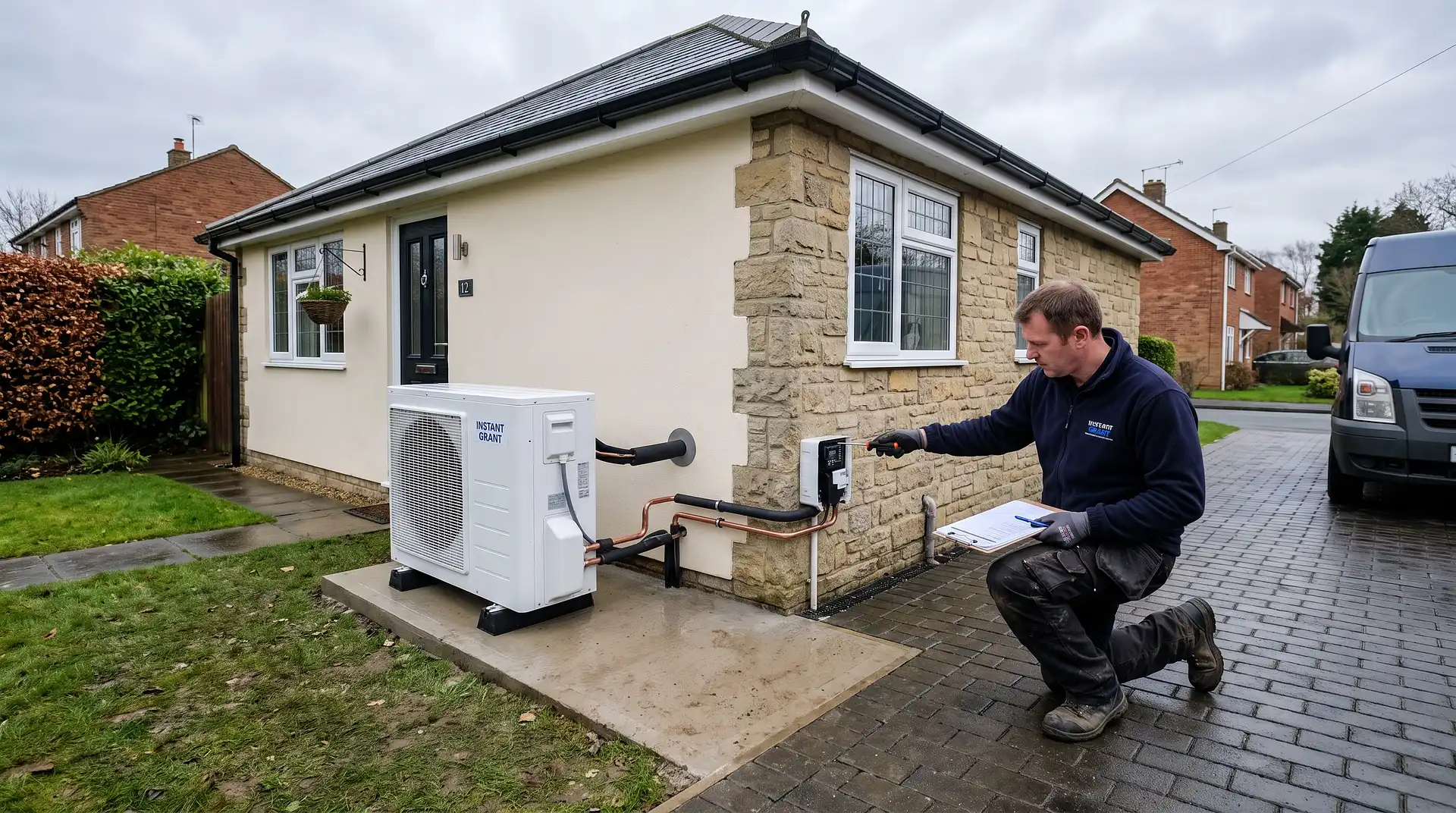
How to Apply for the Boiler Upgrade Scheme
Boiler Upgrade Scheme Guide ·
How to Apply for the Boiler Upgrade Scheme in 2026
The Boiler Upgrade Scheme gives you up to £7,500 off the cost of installing a heat pump in your home, with nothing to repay. If your property runs on oil or LPG rather than mains gas, that figure rises to £9,000 until the end of March 2027. The rules changed significantly in April 2026, and a lot of what you will read elsewhere describes a process that no longer applies.
Please read before continuing: InstantGrant is an independent grant information and application-support service. We are not the UK government, Ofgem, or any funding body. We do not install heat pumps, award grants, or act on behalf of any installer. All information on this page reflects the Boiler Upgrade Scheme rules as updated on 28 April 2026 and verified against GOV.UK and Ofgem guidance in August 2026. Scheme rules can change — always confirm current details with your installer and on GOV.UK before committing to work.
You do not apply for this grant yourself. Your MCS-certified installer does it on your behalf through Ofgem's online system. Your job is to choose the right installer, agree a quote with the grant already deducted, give your consent to Ofgem when they contact you, and pay the balance after installation. This guide walks through every step of that process in the order it actually happens.
What the Boiler Upgrade Scheme Pays in 2026
The grant amount depends on the type of low-carbon heating system you are installing.
System Type | Grant Amount | Notes |
|---|---|---|
Air-to-water heat pump | £7,500 | Standard rate, all eligible properties |
Ground source heat pump | £7,500 | Standard rate, all eligible properties |
Air-to-water or ground source heat pump | £9,000 | Oil and LPG homes only, 21 July 2026 to 31 March 2027 |
Air-to-air heat pump | £2,500 | Domestic properties only, eligible from 28 April 2026 |
Biomass boiler | £5,000 | Rural properties off the gas grid only |
The £9,000 rate for oil and LPG homes is a temporary uplift. Unless the government extends it, it reverts to the standard £7,500 from 1 April 2027. If your home runs on oil or LPG and you are thinking about switching to a heat pump, the window to get the higher figure closes at the end of March next year.
What the Grant Does Not Cover
The grant is a contribution, not a full payment. After the £7,500 or £9,000 is deducted from your installer's quote, you pay the remaining balance. For a typical three-bedroom house with a new air source heat pump, the total installed cost before the grant usually sits between £10,000 and £15,000 depending on property size, existing pipework, and whether radiators need upgrading. The grant makes a significant difference but rarely brings the cost to zero.
Who Can Apply for the Boiler Upgrade Scheme
Property Ownership
You must own the property. That includes homeowners living in their own home and private landlords installing a qualifying system in a rental property they own. Social housing landlords are not eligible.
Location
The Boiler Upgrade Scheme covers England and Wales only. Scotland and Northern Ireland have separate schemes — details are in the regional section further down.
What You Are Replacing
The scheme requires you to be replacing a fossil fuel heating system. That means your current heating must run on gas, oil, LPG, or electricity. The grant is available whether you are in a village in Shropshire heated by an oil tank or a terrace in Cardiff on mains gas. Both situations qualify for the standard rate. Oil and LPG properties qualify for the higher rate.
What Is Not Eligible
Hybrid heat pump systems — where a heat pump works alongside a gas boiler rather than replacing it entirely — are not eligible for the Boiler Upgrade Scheme. This catches people out because some installers promote hybrid systems as a stepping stone. If the quote includes a gas boiler remaining in place, the BUS grant will not apply.
The EPC Requirement: What Changed in April 2026
Before April 2026, applicants needed a valid Energy Performance Certificate showing no outstanding loft or cavity wall insulation recommendations. That rule was removed on 28 April 2026. You no longer need an EPC to apply for the Boiler Upgrade Scheme.
If your property already has a valid EPC, your installer must record its reference number. If there is no valid EPC, your installer submits alternative evidence instead, typically a recent utility bill and photographs of the existing heating system. Ofgem's guidance still recommends getting your home properly assessed before installation because heat pumps run more efficiently in well-insulated properties — but the EPC is no longer a legal requirement to claim the grant.
Step-by-Step: How to Apply
Step 1: Find MCS-Certified Installers and Get Quotes
You cannot apply for the BUS grant yourself. Only an MCS-certified installer can submit the application to Ofgem. Your starting point is finding qualified installers in your area.
Get at least three quotes. This matters more than it might seem. Heat pump installation prices vary considerably between companies, and the cheapest quote is not always the most appropriate. You want to compare the system size specified, the brand and model of the heat pump, what happens to your existing radiators if they need upgrading, and what warranty covers the work.
Check every installer's MCS registration before proceeding. Go to mcscertified.com and search by postcode or company name. An installer who claims to be MCS-certified but does not appear on the register cannot apply for the BUS grant on your behalf — regardless of what they tell you.
Step 2: Ask for a Heat Loss Calculation
Before agreeing any quote, ask your installer to carry out a heat loss calculation for your property. This is a formal assessment of how much heat your home loses through walls, windows, roof, and floor, and it determines the correct size of heat pump needed.
An undersized heat pump will run constantly and struggle to heat the property. An oversized one will short-cycle, wear faster, and cost more to run. Either way, the heat pump underperforms and the savings you expected never materialise. A reputable installer will carry out this calculation without you having to push for it. If they quote a system size without one, that is worth questioning before you sign.
Step 3: Agree Your Quote — Grant Deducted Upfront
Once you choose your installer and agree the specification, the grant value is deducted directly from the quoted price before you pay anything. You pay the remaining balance, not the full amount. The installer then claims the grant back from Ofgem after installation.
Make sure your written quote clearly shows the full installation cost and the grant amount deducted separately. If the quote does not show the grant broken out, ask for it in writing before you sign.
Step 4: Installer Submits the Application to Ofgem
Once you have agreed the quote, your installer submits the BUS application through Ofgem's online portal. You do not need to create an Ofgem account or fill in any forms yourself.
Step 5: Ofgem Contacts You Directly
This is the step that catches many homeowners off guard. After the installer submits the application, Ofgem contacts you independently to confirm that you have consented to the installer acting on your behalf. Respond promptly — delays at this stage hold up the entire process.
Ofgem may also contact you by phone or visit the property after installation to verify the work was carried out correctly. MCS may conduct its own separate checks too.
Step 6: Installation Takes Place
Once the application is approved, installation is scheduled. A typical air source heat pump installation takes two to four days for a standard domestic property. Ground source systems take longer depending on whether horizontal ground loops or boreholes are used.
Step 7: Pay the Balance
After installation is complete, you pay the agreed balance to your installer. The grant has already been deducted from this figure. Your installer then redeems the grant from Ofgem separately.
Air-to-Air Heat Pumps: A New Option From April 2026
Air-to-air heat pumps became eligible for the Boiler Upgrade Scheme on 28 April 2026, with a £2,500 grant for domestic installations. This is a newer addition that most guides have not yet covered properly.
How Air-to-Air Differs From Air-to-Water
An air-to-water heat pump heats water, which then circulates through radiators or underfloor heating to warm the home. This is the type most people think of when they hear "heat pump" and it suits homes with wet central heating systems.
An air-to-air heat pump moves warm air directly around the property using fan units, similar in appearance to air conditioning units. It heats a home without water or radiators, which makes it suitable for properties where a wet heating system would be complex or expensive to install. It does not heat hot water for taps or showers, so a separate hot water solution is needed.
The £2,500 grant for air-to-air systems is lower than the £7,500 for air-to-water, but the installation cost is also significantly lower. For the right property — a flat or a home where underfloor heating is impractical — air-to-air can be a genuinely practical route.
The Budget Question: Should You Apply Sooner Rather Than Later
The Boiler Upgrade Scheme has a budget of £400 million for the 2026-27 financial year, the largest single-year allocation since the scheme launched. That said, earlier scheme years have seen budget run short before the financial year ended, temporarily pausing applications. Nobody can guarantee the same will not happen again.
Applications have been growing. Over 100,000 applications have been processed since the scheme launched in May 2022, with more than 3,500 in February 2026 alone. Demand is increasing as the scheme becomes better known and as heat pump installer capacity grows.
If you are planning to apply, the sensible approach is not to delay waiting for a better deal. The grant amount is set by the government and the same for every eligible property. The only variable you control is timing.
What Happens If Something Goes Wrong
If Your Application Is Rejected
Applications are sometimes rejected because the property does not meet the eligibility criteria the installer assumed, because the system specified is not eligible, or because the evidence submitted was incomplete. If your application is rejected, ask Ofgem for the specific reason in writing. Some rejections are fixable — for example, submitting the correct alternative evidence if the EPC was the issue.
If Your Installer Loses MCS Certification
If your installer's MCS certification lapses between the application being submitted and the installation being completed, the grant claim cannot proceed. This is rare but not unheard of. Check your installer's MCS status before the work begins, not only at the quoting stage.
If You Are Unhappy With the Installation
All BUS-funded installations must comply with MCS standards. If the work is substandard, your first route is to the installer directly. If they do not resolve the issue, you can raise a complaint through MCS's consumer complaint process. MCS-certified businesses are required to participate in a consumer redress scheme.
Combining BUS With Other Schemes
The Boiler Upgrade Scheme can work alongside other government support in some circumstances. A household that qualifies for ECO4 might receive insulation funded through ECO4 first, improving the property's thermal performance before a heat pump is installed using the BUS grant. The two schemes do not conflict but they have different delivery routes and different eligibility criteria, so they need to be arranged separately.
The Boiler Upgrade Scheme cannot be combined with the Warm Homes: Local Grant for the same measure. If your council is funding low-carbon heating through the Warm Homes: Local Grant, you cannot also claim the BUS grant for the same installation.
Scheme Availability by UK Nation
Nation | BUS Available | Grant Amount | Alternative Scheme |
|---|---|---|---|
England | Yes | £7,500 standard / £9,000 oil-LPG (to March 2027) | Warm Homes: Local Grant for some households |
Wales | Yes | £7,500 standard / £9,000 oil-LPG (to March 2027) | Nest scheme for lower-income households |
Scotland | No | Not applicable | Home Energy Scotland (loans and grants) |
Northern Ireland | No | Not applicable | NI Boiler Replacement Scheme / Invest NI |
Scotland
The Boiler Upgrade Scheme does not operate in Scotland. The Scottish Government funds low-carbon heating through Home Energy Scotland, which offers interest-free loans of up to £15,000 alongside cashback grants for heat pump installations. These are available to homeowners across Scotland regardless of income. Contact Home Energy Scotland on 0808 808 2282 for a free assessment — the line is open Monday to Friday.
Properties in rural Aberdeenshire, the Highlands, or Scottish island communities particularly benefit from this route given the high proportion of off-gas-grid homes in those areas.
Wales
Wales is covered by the Boiler Upgrade Scheme. Welsh households can access BUS on the same terms as England. Lower-income households in Wales who do not qualify for BUS because they are tenants or do not meet other criteria may be able to access the Nest scheme through Welsh Government, which covers home energy improvements for lower-income households across the country.
Northern Ireland
Northern Ireland does not have access to the Boiler Upgrade Scheme. Homeowners looking to install a heat pump should contact the Northern Ireland Housing Executive or Invest Northern Ireland to understand what support is currently available. Rural NI has a high concentration of oil-heated properties, and heating support programmes in the region reflect that.
Frequently Asked Questions
Do I apply for the Boiler Upgrade Scheme myself? No. Your MCS-certified installer applies to Ofgem on your behalf. You agree a quote with the grant deducted, give consent to Ofgem when they contact you, and pay the balance after installation.
Has the EPC requirement been removed? Yes, as of 28 April 2026. Properties no longer need a valid EPC to apply. If no EPC exists, your installer submits alternative evidence such as a utility bill and photographs of the existing heating system.
Can I get £9,000 instead of £7,500? Only if your property is currently heated by oil or LPG and has no mains gas connection. The £9,000 uplift runs from 21 July 2026 to 31 March 2027, after which the standard £7,500 applies.
Is the Boiler Upgrade Scheme means-tested? No. There is no income limit, no benefits requirement, and no savings threshold. Any eligible homeowner or private landlord in England or Wales can apply regardless of financial circumstances.
Can private landlords apply? Yes. Private landlords can apply for the BUS grant on properties they own and let to tenants. Social housing landlords cannot.
Are hybrid heat pumps eligible? No. Hybrid systems, where a heat pump operates alongside a gas boiler rather than replacing it, are not eligible for the Boiler Upgrade Scheme.
How do I verify my installer is MCS certified? Search the MCS installer register at mcscertified.com using your installer's company name or postcode. If they do not appear on the register, they cannot submit a BUS application on your behalf.
Is the Boiler Upgrade Scheme available in Scotland? No. Scotland has its own scheme through Home Energy Scotland, offering interest-free loans and cashback grants for heat pump installations. Call 0808 808 2282 for a free home energy assessment.
What if my BUS application is rejected? Ask Ofgem for the specific rejection reason in writing. Some applications can be resubmitted with corrected evidence. Others may indicate a fundamental eligibility issue with the property or system specification.
How long does the Boiler Upgrade Scheme application take? From initial contact with an installer to installation complete, most BUS applications take 6 to 12 weeks. Ground source heat pump installations involving borehole drilling take longer, sometimes 3 to 5 months from first survey to completion.
How InstantGrant Can Help
Working out whether the Boiler Upgrade Scheme is the right route for your property, what it will cost after the grant, and how it sits alongside other schemes like ECO4 or the Warm Homes: Local Grant takes time to piece together from multiple sources.
InstantGrant is an independent information and application-support service. We help UK homeowners understand their grant eligibility before they commit to an installer, navigate the questions worth asking at the quote stage, and understand how different schemes interact.
We are not the government, Ofgem, or any installer. We do not award grants and we do not guarantee any outcome. What we do is help you walk into the process knowing what to expect.
Check your eligibility at instantgrant.co.uk