What Funding Is Available Under ECO4
ECO4 Guide ·
What Funding Is Available Under ECO4? The Full Measures Guide for 2026
ECO4 funds a specific, defined set of energy efficiency improvements for qualifying households. The exact measures your property receives are determined by a formal home assessment, not by a menu you choose from. Before looking at what is included, there is one important statement from Ofgem that most guides skip: "ECO is not a grant scheme; it is up to the energy companies to determine which retrofit projects they choose to fund, the level of funding they provide, and the Retrofit Coordinator and installers that they choose to work with."
Important: InstantGrant is an independent grant information and application-support service. We are not Ofgem, the UK government, or any energy supplier. We do not determine which measures your property qualifies for. All information on this page is verified against the Ofgem ECO4 Delivery Guidance and Measures Table, Ofgem FAQs for domestic consumers, and instantgrant.co.uk live data as of 5 September 2026. Always confirm current measure availability with your energy supplier or an Ofgem-registered installer.
This matters because even a qualifying household with a qualifying property may be told by one supplier that their project is not being funded in a specific area or that their quota is full. ECO4 closes 31 December 2026. Approaching multiple suppliers or installers if the first declines is always worth doing.
What Funding Is Available Under ECO4: The Eligible Measures
ECO4's measures fall into four main categories. A typical ECO4 package combines measures from more than one category, guided by the two-band EPC improvement target that the scheme requires wherever technically possible.
Insulation Measures
Insulation is the core of ECO4 and the most commonly delivered measure category. The scheme covers several distinct insulation types, each relevant to different property construction types.
Loft insulation. Installed in the loft space above the top-floor ceiling. A new installation brings depth up to the recommended 270mm. A top-up adds material to an existing but insufficient insulation layer. Loft insulation is one of the most common ECO4 measures across all property types.
Cavity wall insulation. Installed by drilling small holes in the outer leaf of a cavity wall and injecting insulating material. Suitable for most post-1920 brick and block-built properties. When installed under ECO4, a 25-year guarantee must be provided — a standard required by Ofgem's delivery guidance that most consumer guides do not mention. Before any cavity wall insulation is installed, an installer must confirm the cavity is clear, dry, and free from bridging that could cause damp penetration.
Internal solid wall insulation. For pre-1920 and other solid-wall properties with no cavity, insulation boards or a timber-framed studwork system are fixed to the internal face of external walls. Slightly reduces room size. Requires repositioning of skirting boards, radiators, and electrical fittings.
External solid wall insulation. Insulation boards fixed to the outside of the building and finished with render. Does not reduce interior space. Planning permission may be required in conservation areas. Suitable primarily for detached and semi-detached properties where exterior access allows.
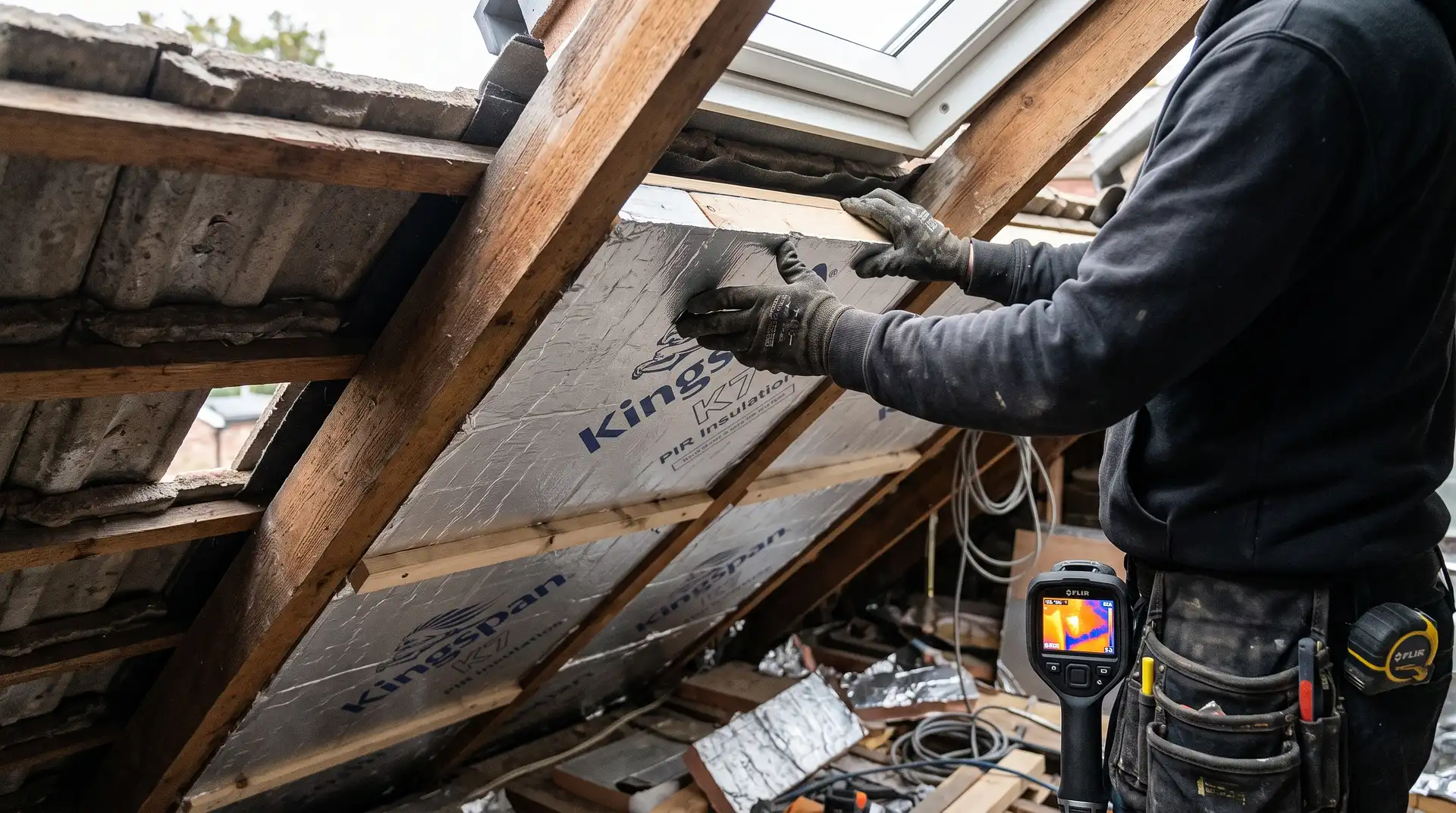
Room-in-roof insulation. This is a distinct measure that most ECO4 guides do not specifically name. It covers rooms within the roofspace of a property — typically a converted loft room with sloping ceilings. Standard loft insulation at ceiling level cannot be used for these rooms because the living space extends into the roof. Room-in-roof insulation lines the sloping rafters and the gable end wall within the habitable roofspace. Properties with converted loft rooms in older housing stock across cities like Bristol, Brighton, and Manchester commonly qualify for this specific measure.
Under-floor insulation. Two types exist: suspended timber floor insulation (mineral wool blown or fitted between floor joists below the floorboards) and solid floor insulation (rigid insulation boards laid on top of a solid concrete floor, then re-levelled). Both are eligible under ECO4 where the assessment identifies them as appropriate.
Flat roof insulation. For properties with flat roof sections, insulation installed into or onto the flat roof structure is eligible where technically feasible.
Park home insulation. Park home residents have access to ECO4 insulation funding through a specific route designed for mobile home structures. The standard ECO4 eligibility rules apply, but the installation method and product types are different from those used in brick or block-built properties. If you live in a park home and qualify through benefits or ECO4 Flex, ask specifically about park home insulation — most installers who handle standard housing stock do not carry out park home work.
Heating Measures
ECO4 can fund heating system improvements where the assessment determines they are necessary to achieve the EPC band improvement target alongside insulation measures.
Boiler repair or replacement. Where a property has a gas boiler that is old, inefficient, or has broken down, ECO4 can fund repair or replacement with a modern A-rated condensing boiler. This is not available as a standalone measure in isolation from insulation under the fabric-first requirement — insulation is normally installed alongside or before any boiler upgrade.
Electric storage heater replacement. Properties heated entirely by electric storage heaters can receive replacement with modern, more controllable high-heat-retention storage heaters. This is a significant benefit for older flats and properties without a gas supply across cities with a high concentration of pre-1980 housing stock.
First-time central heating installation. Properties currently without any wet central heating system — heated only by electric panel heaters, storage heaters, or solid fuel — can receive a complete first-time central heating installation. This includes the boiler or heat pump, pipework, and radiators. It is one of the most impactful and highest-value ECO4 measures available.
Air source heat pump. Where the Retrofit Assessment determines a heat pump is the appropriate heating measure, ECO4 can fund the full installation including the external unit, pipework, hot water cylinder, and commissioning.
Ground source heat pump. Where site conditions make a ground source heat pump more appropriate than an air source unit, this is also eligible. Ground source installations are less common under ECO4 due to higher cost and installation complexity.
District heating connection. Where a property is in an area with an existing heat network or district heating scheme, ECO4 can fund the connection of an eligible property to that network. This is an eligible measure that most consumer guides overlook entirely.
Biomass boiler. In rural, off-gas-grid properties where biomass is appropriate, ECO4 can fund biomass boiler installation. This is subject to local air quality restrictions and technical feasibility assessments.
Ventilation Measures
This is the ECO4 measure category that most guides ignore but that affects a significant number of households who receive insulation.
When solid wall insulation is installed under ECO4 — either internally or externally — it significantly reduces the air permeability of the property. Under the PAS 2035 retrofit standard, a ventilation assessment must be carried out before or alongside any insulation measure that would materially change the building's airtightness.
Where the assessment finds existing ventilation is inadequate for the newly insulated building, ventilation measures must be installed as part of the package. This can include:
Trickle vents and window replacement ventilation components in some cases.
Continuous mechanical extract ventilation in kitchens and bathrooms.
Whole-house mechanical ventilation with heat recovery (MVHR) for properties undergoing comprehensive airtightening retrofits.
For households, this means a property receiving solid wall insulation through ECO4 may also receive ventilation improvements they were not expecting, because PAS 2035 requires it for the insulated building to be safe and free from condensation and damp.
Renewable Energy and Smart Controls
Solar photovoltaic panels. Solar PV is eligible under ECO4 where it contributes to the two-band EPC improvement target and the overall package remains within the scheme's technical and financial parameters. Not every ECO4 property receives solar — roof orientation, shading, structural suitability, and the specific EPC improvement strategy for that property all affect whether solar is specified.
Smart heating controls. Smart thermostats and programmable heating controls are eligible as part of a wider ECO4 package. They are rarely the sole measure but are included in some packages alongside insulation and heating upgrades.
What ECO4 Does Not Fund
This is the section most guides omit but that answers some of the most frequently asked questions.
Windows and glazing. ECO4 does not fund double glazing, triple glazing, or secondary glazing. This surprises many households because draughty windows are a clear source of heat loss. Windows are not an eligible measure under the ECO4 Delivery Guidance.
External doors. New front or back doors are not eligible.
Electrical work and rewiring. ECO4 does not cover general electrical improvements, consumer unit upgrades, or rewiring. Where ventilation measures require minor electrical work to connect extract fans, this is covered as part of the ventilation measure, but standalone electrical improvements are not eligible.
Kitchen and bathroom improvements. ECO4 measures are energy efficiency focused. Kitchen units, bathroom suites, and related installations are not eligible.
EV charging points. Electric vehicle chargers are not an eligible ECO4 measure.
Decorating and finishing. Where internal solid wall insulation is installed, some making-good of plasterwork and painting may be required, but decorative finishing beyond functional completion is not covered.
Garden and exterior works. Paths, driveways, and landscaping are not eligible.
The Fabric-First Requirement: Why Insulation Usually Comes First
ECO4 follows a fabric-first approach. The PAS 2035 Retrofit Standard, which all ECO4 installations must comply with, requires that the thermal fabric of the building — walls, roof, floor — is addressed before or alongside heating system changes.
In practical terms, this means a household hoping to receive only a new boiler under ECO4 will usually also receive insulation measures. Where insulation alone can achieve the two-band EPC improvement target, the assessment may specify insulation only. Where both insulation and a heating upgrade are needed to achieve the two-band target, both will be specified.
This is a design feature of ECO4, not an arbitrary decision by the installer. The logic is that insulating a home before upgrading the heating system reduces the size and cost of the heating system needed, improves its efficiency, and produces a more lasting improvement in the property's energy performance.
ECO4 Is Not a Grant Scheme: What This Means in Practice
Ofgem's own consumer FAQ states: "ECO is not a grant scheme; it is up to the energy companies to determine which retrofit projects they choose to fund, the level of funding they provide, and the Retrofit Coordinator and installers that they choose to work with."
This has direct practical implications for households. A property and household that meet all ECO4 eligibility criteria can still be declined by a specific supplier or installer because:
The supplier has reached its annual obligation target for that type of measure in that area.
The supplier's delivery model prioritises certain property types or measure combinations that deliver more carbon savings per pound spent.
The installer network in the area does not have capacity for the specific measures the property needs.
If you are told you do not qualify or that no funding is available, contacting a different ECO-obligated supplier or a different Ofgem-registered installer is always worth doing. Eligibility is a national standard. Funding availability is not.
Disability Benefits and ECO4: A Common Confusion
PIP, Disability Living Allowance, Attendance Allowance, and Carer's Allowance were removed from ECO4's qualifying benefit list in 2022 when the scheme launched. They were eligible under earlier ECO phases, particularly ECO3.
Households who qualified for ECO3 through these benefits may assume they automatically qualify for ECO4. They do not through the standard benefits route. However, they may qualify through ECO4 Flex if they meet the vulnerability criteria their council uses — a health condition worsened by cold is a common ECO4 Flex qualifier that many households receiving disability-related benefits would meet.
ECO4 Measures by Property Type
Property Type | Most Common Measures |
|---|---|
Post-1920 cavity wall semi or terrace | Loft insulation, cavity wall insulation, boiler replacement |
Pre-1920 solid wall terrace or semi | Loft insulation, internal or external solid wall insulation, first-time CH or heat pump |
Converted loft / room-in-roof property | Room-in-roof insulation, cavity wall insulation |
Property without gas supply | First-time central heating, storage heater replacement, heat pump |
Park home | Park home insulation package |
Flat in purpose-built block | Under-floor insulation (top-floor flat: loft insulation), storage heater replacement |
Rural off-grid property | Air source heat pump, solid wall insulation, solar PV |
What ECO4 Covers by UK Nation
ECO4 operates in England, Scotland, and Wales. The eligible measures are the same across all three nations. Northern Ireland is not covered.
Nation | ECO4 Available | Measures Same as England | Alternative |
|---|---|---|---|
England | Yes, closes 31 Dec 2026 | Yes | Warm Homes Local Grant |
Scotland | Yes, closes 31 Dec 2026 | Yes | Warmer Homes Scotland, HES Grant and Loan |
Wales | Yes, closes 31 Dec 2026 | Yes | Nest scheme for lower-income households |
Northern Ireland | No | Not applicable | Affordable Warmth Scheme: 0800 111 44 55 |
Scotland also has Warmer Homes Scotland, delivered by Warmworks, which covers a similar range of measures with no cap on total value. Contact Home Energy Scotland free on 0808 808 2282.
Frequently Asked Questions
What measures does ECO4 fund? Loft insulation, cavity wall insulation, internal and external solid wall insulation, room-in-roof insulation, under-floor insulation, flat roof insulation, park home insulation, boiler repair or replacement, first-time central heating, electric storage heater replacement, air source heat pump, ground source heat pump, district heating connections, biomass boilers (rural off-grid), solar PV, ventilation measures, and smart heating controls.
Does ECO4 cover windows? No. Windows and glazing are not eligible under ECO4.
Does ECO4 fund a new boiler on its own? Not usually. ECO4 follows a fabric-first approach. Boiler replacement is typically funded alongside insulation measures, not as a standalone improvement.
What is room-in-roof insulation under ECO4? Room-in-roof insulation covers the sloping rafters and gable end walls within a converted loft room. Standard loft insulation cannot be used in habitable roofspace rooms. It is a distinct ECO4 measure that many guides do not specifically name.
Is park home insulation available through ECO4? Yes. Park home residents who qualify through benefits or ECO4 Flex can access ECO4 insulation measures through a specific park home delivery route. Ask specifically about park home insulation as not all ECO4 installers carry out this type of work.
Can ECO4 fund ventilation? Yes, where the Retrofit Assessment identifies that solid wall insulation would reduce airtightness to a point requiring ventilation improvement, ventilation measures including MVHR can be funded as part of the ECO4 package.
Do PIP and DLA qualify for ECO4? No. PIP, Disability Living Allowance, Attendance Allowance, and Carer's Allowance were removed from ECO4's qualifying benefit list in 2022. However, households receiving these benefits may qualify through ECO4 Flex if they also meet their council's vulnerability criteria for a health condition worsened by cold.
Is ECO4 a grant? No, in the formal sense. Ofgem confirms that ECO4 is a supplier regulatory obligation, not a grant scheme. It is up to energy suppliers to decide which projects they fund. A qualifying household may still be declined by a specific supplier due to quota constraints or area coverage.
How InstantGrant Can Help
Understanding which ECO4 measures your property might receive, and whether the supplier or installer approach you have used is the only option or just one of several, is exactly the kind of clarity InstantGrant provides.
InstantGrant is an independent grant information and application-support service. We help UK households understand what ECO4 actually funds for their property type, how to approach the process if one supplier has declined them, and what alternatives exist when ECO4 does not cover what they need.
We are not Ofgem, any energy supplier, or any installer. We do not award grants and we do not guarantee any outcome. We help you understand the scheme before committing to any process.
Check your eligibility at instantgrant.co.uk